

A prepared hood can still finish poorly when atomization is unstable. A high volume low pressure spray gun uses more air at lower pressure to control spray velocity.
HVLP helps painters manage broad fans with softer delivery, reducing bounce-back around doors, fenders, bumpers, and quarter panels while supporting steady overlap.
Why HVLP Technology Helps Control Automotive Finishes?
The purpose of a high volume low pressure spray gun is to atomize coating with enough air while limiting velocity, helping more material remain on the panel.
Transfer efficiency still depends on nozzle design, viscosity, distance, pressure, and technique. HVLP works best when the complete setup is correctly matched.
A properly adjusted high volume low pressure spray gun supports cleaner transfer, controlled fan behavior, and consistent coverage across curved edges and broad surfaces.
-
Lower spray velocity can reduce bounce-back near edges.
-
Efficient transfer can place more coating on the surface.
-
Broad fan control supports stable panel overlap.
-
Softer spray behavior suits basecoat and clearcoat work.
Best HVLP Spray Gun for Versatile Automotive Refinish Work
For painters looking for the strongest HVLP option in the current lineup, the Avalon A60 eXtreme HVLP 1.3 mm is a practical choice for professional automotive refinishing.
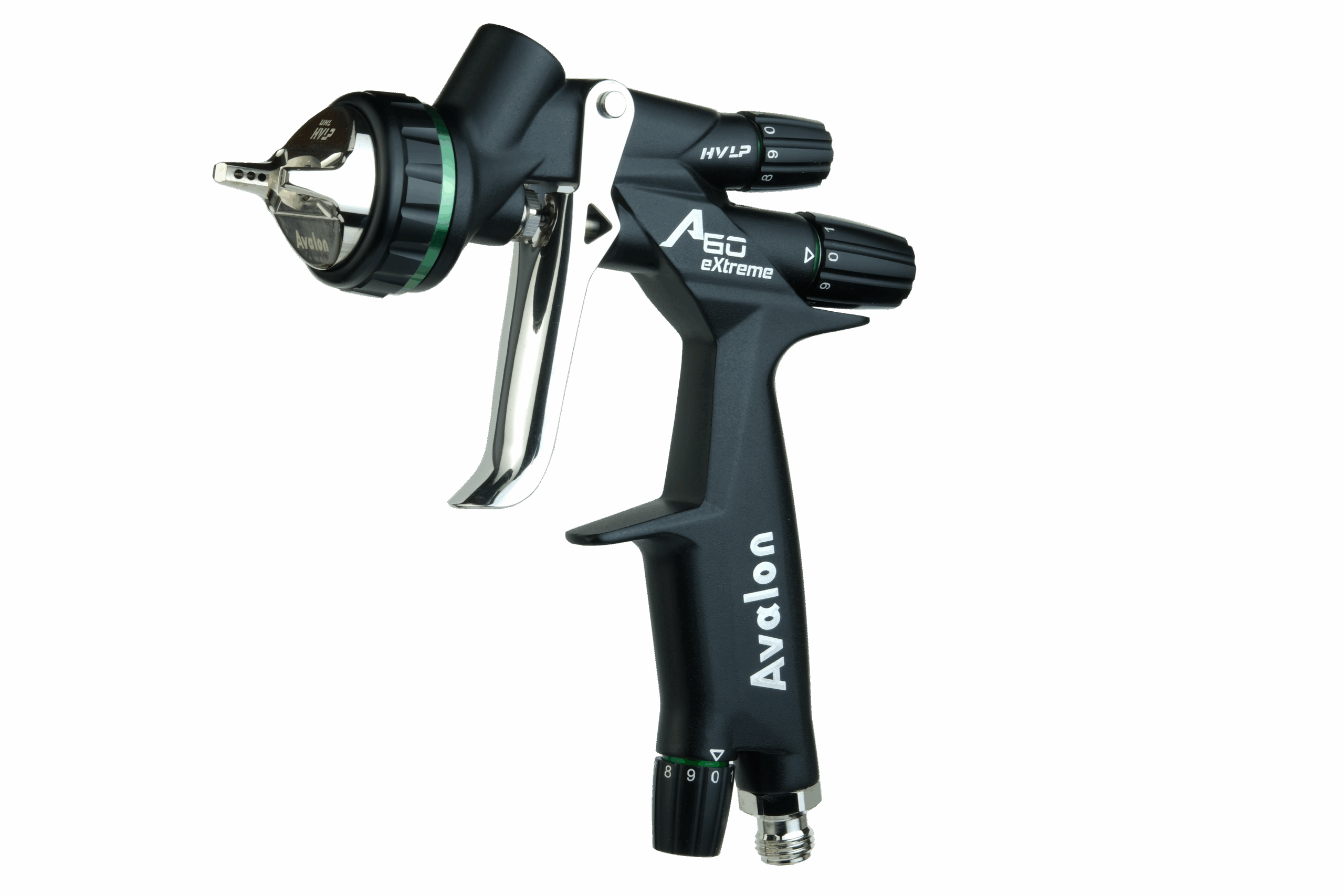
Its 1.3 mm setup is well suited to basecoat and clearcoat, while the U-shaped nozzle, U-groove geometry, and 3-orifice fan cap support controlled atomization across full panels.
With a 34 cm pattern and lightweight 360 g body, this high volume low pressure spray gun offers a balanced combination of coverage, control, and comfort for collision repair, restoration, and custom paint work.
Transfer Efficiency and Overspray in HVLP Spray Work
Automotive testing reported at least 65% transfer efficiency for HVLP, while conventional guns under the same conditions remained below 40%.
In that test, a high volume low pressure spray gun produced a 30% transfer-efficiency improvement and about 50% lower particulate overspray. Occupational spray-painting research documents the results.
Actual percentages vary with coating, pressure, distance, fan width, and technique, so test results should be treated as context rather than a universal promise.
Choosing HVLP Nozzles for Basecoat and Clearcoat Work
Nozzle size changes how a high volume low pressure spray gun delivers coating. Smaller tips tighten control, while larger openings provide stronger output.
For basecoat and clearcoat, Avalon’s A60 eXtreme HVLP 1.3 mm uses a 34 cm pattern, 230 ml/min fluid flow, and a 360 g body.
Another high volume low pressure spray gun setup is the Avalon A-60 HVLP eXtreme 1.4 mm for clearcoat and light primer. The paint gun tip size guide adds context.
-
Check the coating maker’s recommended nozzle range.
-
Confirm compressor output with the trigger open.
-
Test fan shape before spraying the vehicle.
-
Adjust fluid before adding unnecessary pressure.
-
Clean the air cap and fluid tip after use.
Air Supply and Setup for Stable HVLP Spray Patterns
HVLP needs sustained air volume. Restrictions in hoses, couplers, filters, or regulators can weaken atomization even when static pressure appears correct.
A high volume low pressure spray gun should be checked with the trigger open, revealing pressure losses that remain hidden while the gun is idle.
Clean filtration also matters. Moisture, oil, and debris can compromise a finish, while stable air keeps fan and fluid adjustments predictable.
Avalon HVLP Options for Professional Refinish Work
For visible panels, a high volume low pressure spray gun in 1.3 mm balances output and control. Avalon combines a U-shaped nozzle, U-groove geometry, and 3-orifice fan cap.
The 1.4 mm A-60 HVLP eXtreme provides fuller delivery for clearcoat and light primer. Both configurations are currently available through AV Spray Guns.
The table below helps compare each high volume low pressure spray gun setup before checking the coating technical sheet, compressor capacity, and preferred application pace.
| Avalon HVLP setup | Nozzle | Main focus | Typical use |
|---|---|---|---|
| A60 eXtreme HVLP | 1.3 mm | Balanced control | Basecoat and clearcoat |
| A-60 HVLP eXtreme | 1.4 mm | Fuller delivery | Clearcoat and light primer |
Technique Habits for Cleaner HVLP Automotive Finishes
Distance, angle, and travel speed remain important. Keeping the gun perpendicular to the panel helps distribute coating evenly through each pass.
A high volume low pressure spray gun benefits from consistent overlap. Arcing the wrist or changing distance can create dry sections or heavy bands.
Before metallics, pearls, or clearcoat, a test pattern should show balanced edges and an even center. Distortion calls for cleaning or setup checks.
Where HVLP Fits Across Automotive Coating Applications
Basecoat suits a high volume low pressure spray gun because controlled atomization supports even color distribution, particularly with metallic and pearl finishes.
Clearcoat benefits when fluid delivery matches painter pace. The 1.4 mm Avalon option favors fuller flow, while 1.3 mm offers tighter balance.
The automotive HVLP selection guide explains where a high volume low pressure spray gun fits basecoat, clearcoat, light primer, and different panel sizes.
HVLP Applications Beyond Full Automotive Body Panels
HVLP also suits bumpers, mirrors, trim pieces, motorcycle parts, and localized repairs when fan width and material output are adjusted correctly.
A high volume low pressure spray gun handles smaller areas by narrowing the fan and controlling fluid delivery, helping avoid flooded edges and unnecessary overspray.
Compact parts still require stable air, a clean test pattern, correct nozzle choice, suitable distance, consistent overlap, and proper coating preparation.

Maintenance That Preserves Stable HVLP Spray Quality
Regular cleaning keeps a high volume low pressure spray gun from developing pattern problems caused by dried coating. The air cap, nozzle, needle, seals, and fluid passages should remain free of residue.
Why AV Spray Guns Supports Professional HVLP Painters?
At AV Spray Guns, we supply Avalon equipment for collision shops, restoration builders, custom painters, and serious automotive users. Our A60 eXtreme HVLP range includes 1.3 mm and 1.4 mm configurations for different fluid-delivery priorities. We also provide practical setup information so painters can compare nozzle size, airflow, coating type, and panel size before choosing equipment.
-
Choose 1.3 mm for balanced basecoat and clearcoat control.
-
Choose 1.4 mm when fuller clearcoat or light-primer delivery is preferred.
-
Confirm compressor capacity before setting final inlet pressure.
-
Keep the air cap and fluid tip clean for stable atomization.
Our goal is to help painters build equipment around the coating and the job. A high volume low pressure spray gun performs best when nozzle size, airflow, filtration, pressure, and technique support each other.
Avalon HVLP configurations provide practical choices for clean coverage, controlled atomization, and dependable performance across everyday automotive refinishing.