

A technician notices a stone chip beside a wheel arch after the rest of the vehicle has already been refinished. Reopening a broad repair area would waste material and increase blending work, yet a brush would leave the repair too visible. A touch up paint spray gun gives the painter a compact way to place basecoat and clearcoat exactly where the defect requires attention.
Small automotive corrections demand more than a narrow fan. The painter must control fluid delivery, trigger timing, gun distance, air pressure, and the transition into the surrounding finish. A compact Avalon A30 supports that work because its lighter body and available nozzle configurations suit focused repairs where a full-size gun would cover more surface than necessary.
Compact spray guns improve small automotive repair work
For bumper corners, mirror caps, door jambs, rocker edges, and isolated scratches, a touch up paint spray gun helps keep the active spray zone close to the damaged area. The smaller format is easier to position around curves and recesses, while restrained material output reduces the chance of loading the center too heavily during short passes.
Precision also protects the surrounding finish. A broad fan can push color beyond the prepared zone, create extra dry spray, and force the painter to extend the blend. Compact equipment does not remove the need for masking or surface preparation, but it gives the operator a more suitable tool for controlling where fresh material begins to fade into the existing coating.
Another advantage appears during repetitive shop work. For recurring jobs, a touch up paint spray gun can remain dedicated to basecoat, clearcoat, or a frequently used material, reducing setup changes between small jobs. The Avalon A30 Plus platform is available with 0.8, 1.0, 1.2, and 1.3 mm options, giving painters several ways to balance narrow detail work with faster localized coverage.
Prepare each repair before selecting the right A30 setup
Tool choice should follow the defect, not the other way around. A shallow clearcoat mark may need polishing rather than spraying, while a chip that reaches color or primer requires rebuilding the affected layers. Painters should inspect depth, location, panel shape, color type, and available blend space before choosing a nozzle or mixing material.
Once repainting is necessary, the touch up paint spray gun should match the size of the prepared area and the coating being applied. A tiny color correction needs restrained output, whereas a bumper corner with primer, basecoat, and clearcoat may benefit from a broader compact pattern. The coating maker’s technical sheet remains the final reference for reduction, flash time, and recommended application conditions.
Use these checks before loading the cup:
- Confirm that spraying is necessary rather than polishing or filling a chip by hand.
- Keep the repaired substrate smooth and the surrounding blend zone properly prepared.
- Identify whether the job involves solid color, metallic, pearl, or clearcoat only.
- Verify clean air, stable trigger pressure, suitable masking, and enough booth lighting.
- Prepare a test card that resembles the panel orientation and repair size.
A disciplined diagnosis prevents a small defect from becoming a large refinishing task. It also helps the painter reserve the narrowest setups for genuinely tight work instead of expecting one nozzle to handle every bumper, jamb, trim part, and blend edge in the same way.
Choose the Avalon A30 0.8 mm for pinpoint repair detail
For the smallest controlled applications, the Avalon A30 Plus 0.8 mm Ti1 is the strongest starting point. This touch up paint spray gun is built around fine delivery and a compact body, making it suitable for painters who need to keep color or clear close to a very limited repair. Its listed kit includes a regulator, 200 cc cup, PPS adapter, and maintenance tools.
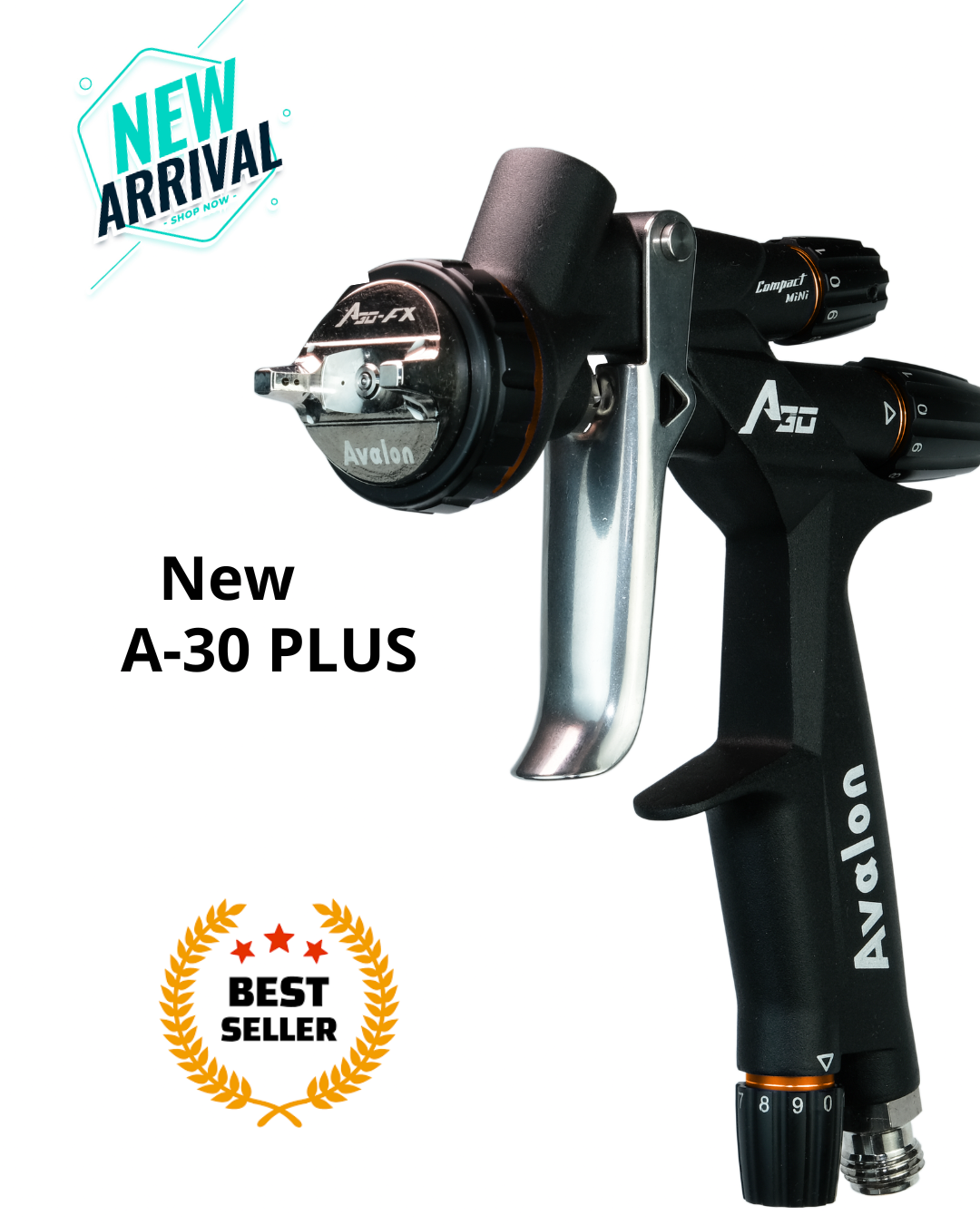
Consider a metallic chip near the edge of a mirror cap. After the defect is prepared and the surrounding surface is ready for blending, the 0.8 mm setup can place light basecoat passes without flooding the center or carrying excessive color around the entire cap. The painter can then widen the fade gradually and apply clear according to the coating system’s approved repair procedure.
Painters choosing a touch up paint spray gun for pin-sized defects should still test atomization before working on the vehicle. The 0.8 mm Ti1 configuration is listed with lower fluid output than the larger A30 options, but viscosity, reducer, temperature, and trigger movement still affect the result. Buy the Avalon A30 Plus 0.8 mm when pinpoint placement and restrained delivery define the job.
Match every Avalon A30 nozzle to a specific repair task
Each available A30 configuration serves a different practical role. The 1.0 mm option gives more output than the 0.8 mm version while preserving compact control. The 1.2 mm CH supports medium localized repairs, and the 1.3 mm CH offers the fastest coverage in the compact group. Those differences help a shop assign one gun to each recurring type of automotive work.
In practice, a touch up paint spray gun should never be selected by nozzle number alone. Air-cap behavior, coating viscosity, fan setting, distance, and operator speed influence how the material reaches the panel. The spray gun tip size planning used in the shop should connect each A30 setup with an actual repair category and a repeatable test-card routine.
The table below helps painters compare the four currently listed A30 sizes by practical automotive purpose. The examples are application recommendations based on their relative fluid output and pattern range, so the final setup must still follow the coating maker’s instructions and a spray-out check.
| Avalon A30 setup | Specific automotive purpose | Example repair |
|---|---|---|
| 0.8 mm Ti1 | Pinpoint color and clear placement | Stone chip beside a wheel arch |
| 1.0 mm | Balanced precision on tight sections | Basecoat blend inside a door jamb |
| 1.2 mm CH | Medium spot repair with fuller coverage | Scraped bumper corner after primer |
| 1.3 mm CH | Faster coating on compact replacement parts | New mirror housing or small spoiler section |
Control blend edges without widening the repair area
A clean blend depends on keeping the strongest color over the repair and reducing material toward the outer edge. With a touch up paint spray gun, the painter can shorten the trigger cycle, narrow the pattern, and use controlled passes that suit the available space. The goal is a gradual transition, not a hard ring of concentrated basecoat around the defect.
Metallics and pearls deserve extra care because air pressure, wetness, and pass direction can change particle orientation. A small test panel helps reveal whether the blend appears darker, lighter, or coarser than the original finish. When the color is close, lighter extension passes can soften the boundary without carrying the repair farther across the panel than necessary.
During this stage, a touch up paint spray gun should remain square to the working surface whenever panel shape allows. Excessive wrist rotation can load one side of the pattern and leave the opposite side dry. The documented color and clearcoat blending method also shows why practice panels are valuable before applying a blend to the actual vehicle.
Set air and fluid for repeatable close-range spraying
Compact spraying still requires stable air delivery. A regulator should be checked with the trigger fully pulled, and the hose must supply enough volume for the selected cap. Begin with the coating maker’s guidance, then inspect the test pattern for a balanced center, clean edges, and consistent material distribution before approaching the vehicle.
During adjustment, the touch up paint spray gun should be changed one variable at a time. Changing pressure, fluid, fan width, reducer, and distance together makes the result difficult to repeat. A practical sequence keeps the painter focused on the pattern and reduces the chance of correcting one issue while creating another.
Follow this five-step setup routine:
- Filter the mixed coating and load only the amount needed for the repair.
- Set inlet pressure with the trigger fully open.
- Establish fan width on a test card that matches the repair scale.
- Adjust fluid delivery until atomization is even without excessive dry spray.
- Recheck the pattern after the gun has sprayed long enough to confirm stable air supply.
Close-range work can tempt painters to slow down too much. That usually places excess material in the center and increases the risk of mottling, sagging, or a visible edge. Keep the gun moving smoothly, release the trigger at the end of each short pass, and allow the specified flash period before deciding whether another coat is required.
Avoid common errors during automotive spot repairs
One frequent mistake is using a touch up paint spray gun as though it were a full-size panel gun. The compact format is designed for focused control, so overly wide passes and extended wet coats can defeat its advantage. Another problem is narrowing the fan without reducing fluid, which concentrates material and can create a heavy stripe through the center of the repair.
Poor masking also causes avoidable rework. Hard tape lines placed too close to the color area can leave an obvious boundary, while insufficient vehicle covering allows overspray to settle on adjacent panels. The repair should have enough prepared space for the basecoat transition and any approved clearcoat procedure without exposing unrelated surfaces.
Cleaning errors can affect the next touch up paint spray gun session as well. Dried material around the air-cap holes may distort the fan, and a damaged needle or nozzle can cause spitting during short trigger pulls. Use the supplied maintenance tools carefully, avoid forcing metal objects into precision openings, and inspect seals before returning the gun to service.
Clean the compact spray gun without harming fine parts
A compact gun should be cleaned immediately after the coating session. Empty remaining material according to shop procedure, flush the fluid path with the compatible cleaner, and wipe the exterior without soaking the complete gun body. Removing residue while it is still soft reduces the need for aggressive cleaning later.
Because a touch up paint spray gun uses small fluid components, careless handling can affect atomization quickly. The nozzle should be loosened with the correct tool, the needle should be protected from bending, and the air cap should be cleaned with a suitable soft brush. Reassembly must be firm but not excessively tight, especially around fine threads and seals.
Storage matters after cleaning. Hang or place the gun where the regulator, cup connection, and air cap cannot be struck by other tools. Keep dust away from the fluid passage, and label dedicated guns clearly when one unit is reserved for basecoat or clearcoat. That simple organization reduces contamination risk during fast repair cycles.
Know when a full-size spray gun is the better tool
Not every repair belongs to a touch up paint spray gun. A complete hood, full door, broad quarter-panel clearcoat application, or large replacement panel usually needs the fan width and productivity of a full-size Avalon A60. Trying to cover a broad surface with a compact gun can create too many overlaps, inconsistent wetness, and unnecessary fatigue.
The A30 remains valuable when the repair is contained around edges, recesses, small parts, bumper sections, jambs, and controlled blend zones. Additional compact automotive applications include mirror caps, helmets, trim, spoilers, and other shaped components where broad coverage would add overspray without improving the finish.
A shop gets the best value when each touch up paint spray gun has a defined assignment beside the main refinish gun. The 0.8 mm unit can remain dedicated to tiny detail work, the 1.0 mm version can cover tight basecoat and clearcoat tasks, the 1.2 mm CH can handle bumper spot repairs, and the 1.3 mm CH can support quicker work on small parts.
Choose Avalon precision support from AV Spray Guns
At Avalon Spray Guns, we help automotive painters select an Avalon A30 according to repair size, coating type, required output, and available blend space. Our current compact lineup includes 0.8, 1.0, 1.2, and 1.3 mm options, so a technician can choose restrained detail delivery or faster compact coverage without forcing one configuration into every job.
- Choose the A30 Plus 0.8 mm Ti1 for pinpoint detail and the smallest blends.
- Select the A30 Plus 1.0 mm for balanced control on jambs and trim sections.
- Use the A30 Plus 1.2 mm CH for bumper corners and medium spot repairs.
- Pick the A30 Plus 1.3 mm CH for faster coverage on compact automotive parts.
Our team keeps every recommendation centered on Avalon equipment available through AV Spray Guns. Bring us the repair type, coating system, compressor details, and preferred spray style, and we will help narrow the suitable A30 configuration. Shop the Avalon A30 lineup and equip your next automotive detail repair with the control, output, and compact handling the job actually requires.