

A painter can prep the panel correctly, mix the coating carefully, and still fight texture if air pressure changes at the handle. A paint gun regulator keeps the final adjustment close to the Avalon spray gun, where the trigger, hose, coupler, and booth routine all meet. That small part helps turn air supply into a steadier fan, especially when basecoat, clearcoat, sealer, or primer needs repeatable control.
In daily refinishing, paint gun regulators are not accessories for decoration. They help painters read pressure at the gun inlet, correct small pressure drops, and avoid guessing when the fan begins to dry out or push too much material. On Avalon A-60 and A-30 setups, the regulator should be treated as part of the spray system, not as a loose add-on that only matters during setup.
Why inlet pressure changes every Avalon spray pass?
A paint gun regulator is useful because pressure does not remain identical across the whole air path. The compressor, wall filter, hose length, quick connector, and trigger demand can all influence what reaches the gun during real spraying. Reading pressure only at the wall may hide a drop that appears when the trigger is fully pulled and the gun starts consuming air.
Professional paint gun regulators help separate three different checks: wall supply, line stability, and gun inlet adjustment. The regulator at the handle does not replace good filtration or a suitable compressor, but it gives the painter a more practical final point of control. That matters with Avalon HTE, MP, HVLP, and compact models because each one depends on stable air behavior to keep atomization clean.
Before a panel reaches the booth, review these pressure basics:
- Pull the trigger while checking pressure, not while the gun is idle.
- Use clean, dry air so moisture does not disturb the finish.
- Keep hose and coupler restrictions low enough for the gun’s air demand.
- Recheck the fan after changing coating, reducer, tip size, or temperature.
Signs your gauge is no longer helping finish quality
A worn paint gun regulator can create problems that look like bad technique. The fan may pulse, the gauge needle may stick, or the reading may change slowly after each trigger pull. In other cases, the adjustment knob feels loose, air leaks around the fitting, or the painter keeps chasing orange peel and dry spray even after correcting distance and overlap.
Several paint gun regulators should be replaced when they no longer hold a steady setting, when the lens is damaged, when the gauge is hard to read, or when the inlet fitting has been hit hard enough to bend. A regulator that has been exposed to solvent, booth dust, moisture, and repeated drops can keep looking usable while giving unreliable feedback.
The table below helps connect common symptoms with practical action. It is meant to support quick shop checks before blaming the Avalon gun, the coating, or the painter’s hand speed.
| Shop symptom | Likely regulator issue | Practical response |
|---|---|---|
| Fan changes during one pass | Inlet pressure is drifting | Check the setting with trigger pulled |
| Gauge needle sticks | Internal gauge wear or contamination | Replace the regulator assembly |
| Small air leak at handle | Damaged thread, seal, or fitting | Inspect fitting and reseal if suitable |
| Dry spray after normal setup | Pressure reading may be inaccurate | Compare with a known good unit |
Avalon AR-080 choice for controlled air inlet work
For Avalon users who need better inlet control, the Air Regulator AR-080 is the most direct option in the AV Spray Guns catalog. This paint gun regulator uses a G1/4 thread fitting with 360° turning and 20° tilting, which helps the hose sit more comfortably while the painter checks pressure close to the gun. That matters when the goal is to keep the fan stable before spraying basecoat, clearcoat, sealer, or primer.
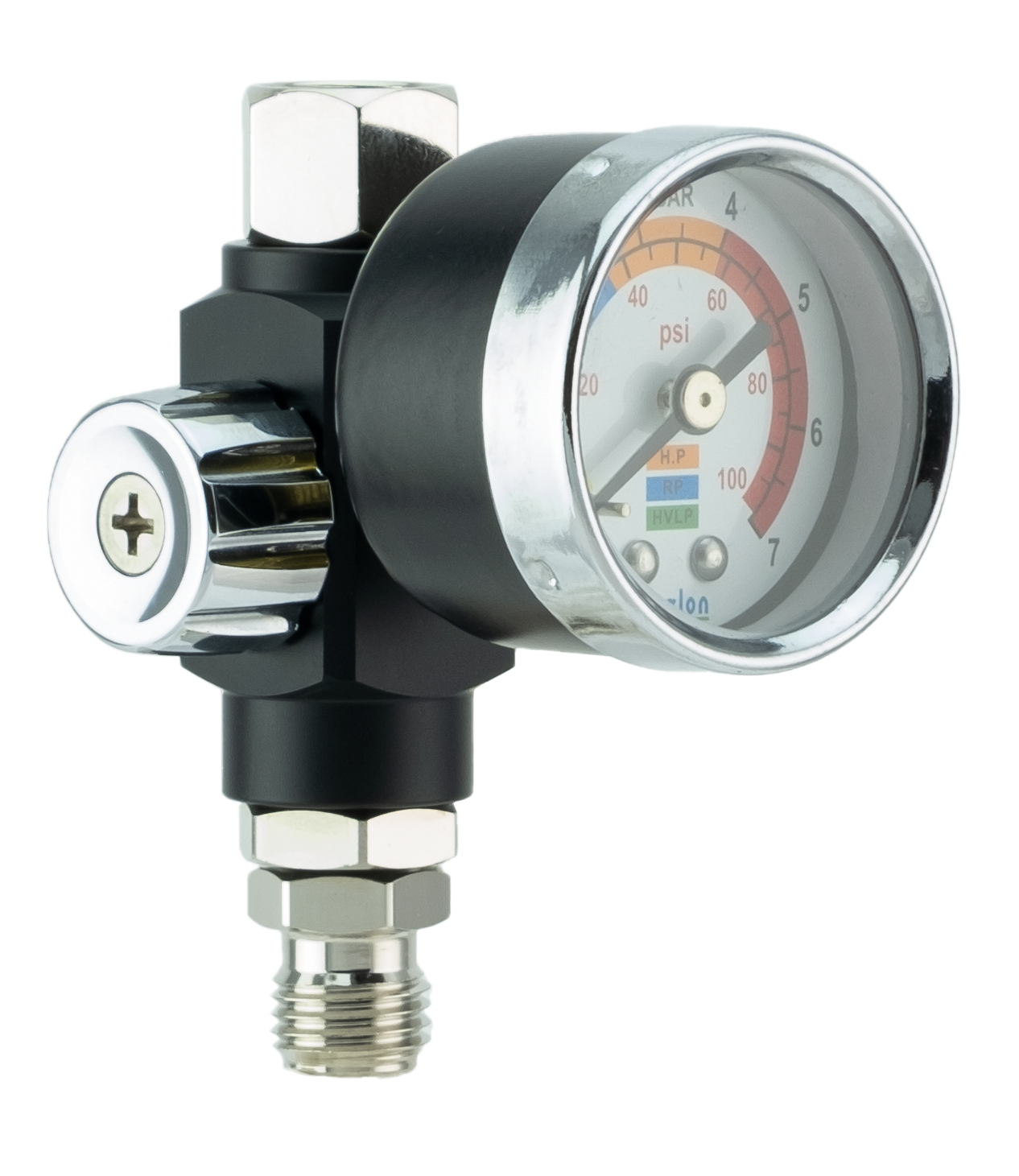
When paint gun regulators start leaking, drifting, sticking, or giving hard-to-read pressure feedback, replacing the part is usually safer than continuing to adjust by guesswork. A small pressure issue can turn into dry spray, uneven atomization, or wasted material. For painters using Avalon spray guns, the AR-080 keeps the setup aligned with the equipment already in use.
Ready to improve pressure control at the gun? Add the Avalon Air Regulator AR-080 to your setup and keep every spray pass easier to dial in.
Common pressure habits that protect clearcoat work
Clearcoat reacts quickly when paint gun regulators are ignored. Too little air can leave coarse texture, heavy edges, and weak break-up. Too much air can increase bounce-back, dry the edge of the fan, and waste material before the film has time to flow. A short spray test on masking paper remains one of the simplest ways to check whether the fan looks balanced.
Use this five-step routine before spraying visible panels:
- Attach the regulator firmly and confirm the gauge is readable.
- Open the gun controls according to the coating and test plan.
- Pull the trigger fully before setting inlet pressure.
- Spray a short pattern on paper and read the fan edges.
- Adjust one variable at a time before coating the panel.
A paint gun regulator should also be paired with the correct nozzle choice. Pressure cannot rescue a tip that is too small for the material or too large for the panel size. Avalon A60 1.3 mm and 1.4 mm setups behave differently with basecoat, clearcoat, sealer, and light primer, so tip selection for refinishing should be reviewed together with air setup.
When paint gun regulators are used consistently, the painter can repeat a successful setup more easily. The goal is not to chase a number for its own sake. The goal is to make the fan stable, keep the coating breaking up cleanly, and avoid changing pressure, fluid flow, and travel speed all at once. A pressure test such as the spray pattern pressure test is useful because it links air adjustment with the way the pattern actually looks.
Frequent doubts before replacing air regulator parts
A paint gun regulator is usually ready for replacement when it leaks, gives slow readings, cannot hold a setting, has visible damage, or no longer matches the behavior of a known good regulator. Painters should also replace it after a hard impact if the gauge or fitting may have been affected. A small regulator failure can create wasted clear, extra sanding, and avoidable refinishing time.
Many paint gun regulators are changed too late because the painter assumes every finish defect comes from technique or material. Technique matters, but unstable air can imitate common defects. If two Avalon guns behave poorly on the same line, the shop should inspect filtration, hoses, and wall supply. If one gun changes immediately after swapping regulators, the smaller part has likely revealed the problem.
Another common doubt is whether the regulator should stay on the gun all the time. In most shop routines, leaving it attached is practical if the gun is stored safely and the regulator is not exposed to impact. During cleaning, avoid soaking the gauge assembly in solvent. Clean the gun properly, protect the lens, and keep air fittings free of debris before the next session.
AV Spray Guns support for Avalon pressure control daily
At AV Spray Guns, we help Avalon users treat paint gun regulators as part of a complete refinishing setup. We look at the gun model, coating type, compressor capacity, hose layout, and daily work before recommending an inlet-control routine. Our focus stays on Avalon equipment, including the A-60 platform, A-30 compact guns, replacement parts, and the AR-080 regulator when that is the right fit for the user’s workflow. The goal is to help each painter protect finish quality before material reaches the panel, with advice that matches the gun in hand.
- We guide users toward Avalon parts that match their spray gun.
- We help connect pressure habits with basecoat, clearcoat, sealer, and primer work.
- We support shops that need replacement parts, setup help, and practical troubleshooting.
- We keep recommendations centered on real refinish use, not generic accessory lists.
Our support is built for painters who want equipment that behaves predictably on the panel. We also help users think through storage, cleaning, thread care, gauge readability, and setup habits, because small routines keep air control dependable. When the regulator setup is selected and maintained correctly, the Avalon spray gun can do its job with steadier atomization, cleaner fan control, and fewer avoidable interruptions. The regulator is a small part, but it helps protect the larger investment: the coating, the panel, the booth time, and the final finish.