

The first time someone shops for a paint gun pistol, the search usually starts in the wrong place. Price comes first. Shine comes second. A few bold claims do the rest. Then the real question appears later, usually after too many tabs and too many options that look almost identical: which tool will still make sense when the work becomes serious?
That is the moment when Avalon starts to stand apart. This is not the kind of brand that feels built around a quick sale or a low-price shortcut. It feels built for the painter who notices how a fan opens, how a coating settles, and how much easier the day becomes when the gun works with the hand instead of against it.

For anyone starting from zero, that difference matters more than it first seems. A first professional choice should not be a random purchase that looks impressive for a week and then starts to feel limiting. It should be a tool that supports cleaner finishes, steadier control, and better habits right away.
See Our Catalog
That is why Avalon deserves attention before the model names even show up. Once the brand value is clear, the rest becomes easier to understand. Then the choice between the A60 and the A30 stops feeling confusing and starts feeling practical, which is exactly what a professional purchase should do.
What should shape your first decision?
A strong first purchase usually begins with the right questions. Not because buying a spray gun has to feel complicated, but because the wrong first question leads straight to the wrong tool. The goal here is to clear the fog before model numbers start crowding the decision.
These are the questions worth carrying through the rest of the article. Each one gets answered as the comparison sharpens, so the final choice feels grounded in real work rather than in product-page excitement or guesswork.
- Do you need one main gun for panels, base, clear, and steady refinishing work?
- Do you need a compact gun for tighter areas, smaller parts, and closer control?
- Are you trying to save money today, or avoid buying twice later?
- Do you care enough about finish quality to feel differences in pattern behavior and comfort?
- Would your work benefit more from the A60 or from the smaller, more focused A30?
Why does Avalon feel different so quickly?
Some brands ask for trust before they earn it. Avalon tends to do the opposite. The appeal shows up in the way the guns are described and in the type of painter they seem built for: someone who values smooth application, fine atomization, efficient transfer, and a body that stays comfortable through real work.
That matters because a professional spray gun should not feel like a gamble. It should make sense on paper and in the hand. Avalon’s language around control, lightweight construction, and finish quality gives the brand a more focused identity than the usual vague promise of “pro performance.”
The nozzle design is a big part of that identity. Avalon ties much of its finish character to a U-shaped nozzle concept, while AV Spray Guns frames the same idea as a U-Split tip with dual atomization. In practical terms, the message is simple: finer breakup, smoother delivery, and more composed spray behavior.
That technical personality changes the buying logic. Instead of comparing random spray guns only by price and nozzle size, the buyer starts comparing systems of use. One tool feels generic. Another feels like it was designed around a known result. That shift is one of the strongest reasons Avalon attracts serious attention.

There is also a comfort signal in the range. Lightweight bodies are not a side detail when passes need to stay steady and repeatable. Hand fatigue is rarely dramatic, but it quietly changes control, timing, and consistency. A gun that reduces that strain has value long before the job is over.
The wider point is simple. Avalon feels different because it reads like a brand built for painters who care about the finish enough to notice the tool. That is a much stronger foundation than choosing a spray gun just because it happens to be on sale or easy to find.
How do the A60 and A30 divide the work?
Once the brand makes sense, the lineup becomes much easier to read. Avalon’s visible professional path is not crowded with endless overlap. It is easier to understand as two working directions: the A60 as the main refinishing route and the A30 as the compact precision route.
That difference is important because first-time buyers often make the same mistake. They look for one gun that will do everything equally well. In real work, that usually creates compromise. Avalon’s two-family logic avoids that trap by making the split between main-gun duties and compact-gun duties much clearer.
The table below is useful because it organizes the choice by role, not by hype. It helps show what each family is really trying to solve, which makes the final decision more logical for a painter who wants a tool that fits the job rather than a tool that simply sounds impressive.
| Family | Core role | What stands out | Best fit |
|---|---|---|---|
| A60 | Main professional refinishing gun | Strong family identity, U-shaped nozzle logic, multiple spray approaches | Full panels, basecoat, clearcoat, steady booth work |
| A30 | Compact precision gun | Lightweight body, low air use, close control, detail-friendly handling | Touch-ups, smaller parts, spot repair, tighter areas |
That comparison also clears up the naming. The A60 carries the more developed family language with HTE, HVLP, and UMP variations, while the A30 shows up as A30 Plus and A-30 Mini in the compact branch. That is useful because it makes the lineup easier to understand without forcing false symmetry.
Once that split is clear, the decision becomes less emotional and more practical. The buyer is no longer asking which one sounds more advanced. The better question is which one matches the work that fills most of the week, and that is the question that leads to a better first purchase.
Why does the A60 become the main gun so often?
For many painters, the A60 becomes the natural entry into Avalon because it carries the strongest main-gun identity. It looks and feels like the family meant to handle the work that defines the day: larger surfaces, central booth tasks, and finishes where consistency matters over many passes, not just one.
Its appeal starts with breadth inside the same family. The A60 is not one fixed spray behavior with different stickers. It opens into HTE, HVLP, and UMP directions, giving painters a more specific way to choose how they want the gun to respond without leaving the line that already fits their finish standards.
The HTE version is the easiest place to see that. It is built around a new airflow system and a U-groove nozzle design intended to create finer droplets and a more controlled spray pattern. That makes the gun especially attractive when transfer efficiency and a composed fan matter as much as raw coverage.

That is why the A60 HTE makes such a convincing first serious choice. It gives the painter a main-gun feel with a finish-driven personality. It does not read like a general-purpose compromise. It reads like a tool meant for someone who wants better control over base, clear, metallics, pearls, and related refinishing work.
The HVLP version shifts the feel in a different direction. Its airflow design pre-atomizes the paint before it leaves the cap, and the fan cap layout is shaped for a wider spray pattern. That matters when the painter wants steadier panel coverage and a more relaxed sense of control through each pass.

A wider, more even pattern is not just a spec-sheet talking point. It changes how the job feels on larger panels and highly visible areas. When the gun helps keep the application smooth and the material use more efficient, the painter spends less energy correcting the process and more energy maintaining quality.
The UMP version adds another useful angle. Its airflow and slight U-groove nozzle design refine the paint before fan formation while keeping air consumption relatively low. That combination gives the A60 line a more balanced option for painters who want fine atomization without sacrificing a fast, usable rhythm.
That balance is one of the strongest reasons the A60 feels like a real platform instead of a single star product. It allows a painter to choose based on working style. One person may prefer the transfer-focused character of HTE. Another may lean toward the broader control of HVLP. Another may want the balanced feel of UMP.
Price reinforces that professional reading. The A60 sits in a premium tier, with visible store pricing around the high five hundreds and upper five nineties depending on the version shown. That does not make it the right gun for everyone, but it clearly places it beyond the throwaway-upgrade category.
That premium position makes the most sense in expert hands or in the hands of a buyer who wants to grow into a professional standard quickly. A refined main gun only pays off fully when the painter values what it brings: steadier pattern behavior, cleaner finish potential, and a body designed for repeated professional use.
So why does the A60 become the main gun so often? Because it answers the biggest need in a serious paint setup. It gives the painter a central tool that feels deliberate, not temporary, and that is exactly what a first professional investment should do when the goal is to build a better standard, not just finish the next job.
When is the A30 the smarter move?
The A30 matters because professional work is not always full-panel work. Many jobs reward tighter control more than broad coverage. In those cases, a compact spray gun is not a compromise. It is the more intelligent answer, especially when the painter wants precision without giving up finish quality.
The A30 Plus speaks clearly to that role. It is lightweight, compact, and built for fine, precise atomization. It also covers a broader range of smaller-scale work than many buyers expect, handling touch-ups, automotive work, and other painted objects where controlled delivery matters more than a large-body feel.
That broader usefulness is important. The A30 should not be read as a toy or as a backup chosen only when nothing else fits. It makes sense for smaller parts, controlled custom work, tighter repair zones, and any job where the painter benefits from being physically closer to the surface with more confidence.
The A-30 Mini sharpens that identity even more. At 256 grams, it is clearly built for low-fatigue handling. It is also described around door panels, bumper repairs, and small-area detailing, which gives the compact Avalon route a very practical and believable role inside a professional setup.

That low weight matters more than it may seem at first glance. Close-detail work depends heavily on steadiness. A smaller body that remains comfortable through repeated hand movements makes it easier to stay composed around edges, repair zones, and areas where over-application becomes obvious very quickly.
The nozzle options strengthen that role. The A-30 Mini is shown with 0.8 mm, 1.0 mm, and 1.2 mm variations, each aligned with a different kind of detail work. That allows the painter to keep the compact format while still tuning the gun toward ultra-fine detail, small panels, or slightly broader spot-repair tasks.
This is exactly why the A30 should not be viewed as “the smaller A60.” That reading is too simplistic. The A30 is better understood as a compact specialist. It serves the painter who needs control, agility, and comfort on work that benefits more from precision than from a full main-gun profile.
It can also attract a slightly wider audience without losing its professional core. Anyone working on compact parts, smaller coated objects, trim pieces, or controlled finish work can see the appeal. The A30’s language supports that interest because it is not boxed into a single narrow task.
For a buyer starting from zero, the A30 becomes the smarter move when the weekly workload rewards closeness, not reach. If the painter’s reality is mostly spot work, smaller surfaces, contained repairs, or tighter visual control, the compact Avalon route becomes much easier to justify.
Why pay more for Avalon?
The simplest answer is that Avalon is not selling a bare minimum tool. It is selling a finish-oriented experience built around atomization quality, airflow behavior, efficient transfer, and a clearer product logic. Those advantages matter most when the painter is experienced enough to feel them or motivated enough to grow into them.
A cheaper spray gun can still put material on a surface. That is not the real question. The real question is whether it can do so with the same comfort, consistency, and finish potential when the painter is trying to hold a higher standard over repeated jobs. That is where Avalon tries to separate itself.
Part of the price goes into a better match between tool and task. The A60 is not pretending to be the ultimate detail gun, and the A30 is not pretending to be the ideal answer for every full-panel workflow. That clarity protects the buyer from the common mistake of asking one tool to solve every problem.

Another part of the value shows up around the gun. Replacement parts and air caps are visible inside the same ecosystem, and the brand is sold through an authorized distribution setup. For a professional buyer, that matters because the purchase feels supported instead of isolated.
That support changes the emotional side of the purchase too. A premium tool feels easier to trust when it does not live in a dead end. Knowing that there is a path to parts, continuity, and a defined range around the gun makes the investment feel more deliberate and less risky.
So why pay more? Because Avalon is built for painters who care enough about the finish to choose on purpose. In that setting, the higher price is not just a brand tax. It is part of stepping into a tool that is meant to support professional habits, not just temporary convenience.
What does the U-Split design really change?
The U-Split idea matters because it gives Avalon a real technical identity. Instead of describing its spray guns with generic language, the brand ties much of its performance story to a U-shaped nozzle design intended to improve atomization and pattern quality in a noticeable way.
In everyday terms, that means the gun is trying to break the material more cleanly before it fully forms the fan. When that happens well, the result is not just “more spray.” The result is a finer, smoother, more controlled application that gives the painter a stronger chance at an even finish.
The HTE version uses that design to support high transfer and a controlled, elongated pattern. That makes it appealing to painters who want clean, efficient delivery and a fan that feels composed on material where finish quality is highly visible.
The HVLP version uses the same core logic differently. There, the airflow pre-atomizes the paint before the final exit, helping build a wider pattern and a more controlled sense of coverage. That makes it especially attractive for larger visible areas and painters who want steadier fan behavior.
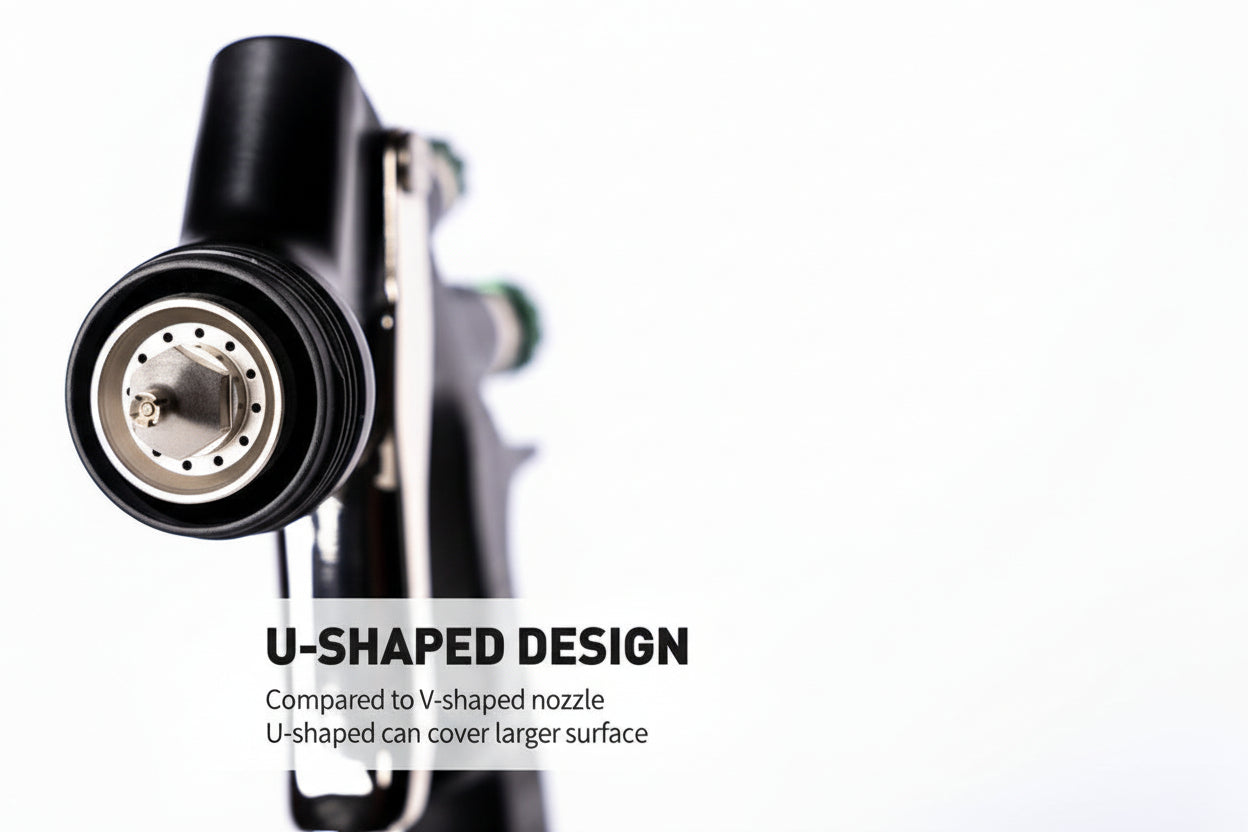
The UMP version turns the design toward balance. It refines airflow, supports pre-atomization, and keeps air use relatively low while preserving a fine, even spray pattern. That is valuable when the painter wants speed and control to coexist rather than trade places.
This is why the nozzle concept matters so much to Avalon’s identity. It is not a decorative feature that sits on top of the product story. It is the technical thread that helps explain why the A60 family is positioned as smoother, finer, and more controlled in the first place.
5 signs you are choosing the right Avalon
A first professional spray gun does not have to feel like a leap in the dark. There are several clear signs that the choice is moving in the right direction. They all come back to the same idea: the best gun is the one that fits how you actually work, not the one that sounds the most dramatic in a sales line.
-
You know whether your week needs a main gun or a compact gun.
If your work is centered on panels, base, clear, and repeated booth use, the A60 makes more sense as your starting point. If your work is dominated by tighter repairs, smaller parts, and closer visual control, the A30 becomes the more intelligent route. -
You care about pattern behavior, not just output.
HTE, HVLP, and UMP are not empty labels. They reflect different spray personalities inside the A60 family, which means the buyer can choose based on the feel of application instead of pretending every setup responds the same way. -
You recognize that comfort affects finish quality.
A tool that stays comfortable helps the hand stay consistent. The lightweight emphasis in the A60 family and the 256-gram body of the A30 Mini both point to the same truth: a better-feeling gun can support steadier, cleaner work over time. -
You want a tool that belongs to a system.
A serious purchase should not feel stranded. The visible ecosystem around Avalon includes finished guns, air caps, and replacement parts through an authorized sales channel, which gives the buyer a clearer sense of continuity and support. -
You care enough about the finish to choose deliberately.
If smooth application, fine atomization, lower waste, and a more professional result sound like real priorities rather than marketing fluff, Avalon is already speaking the right language for your work. That alignment is one of the strongest signs you are looking in the right place.
What should your first professional step look like?
The strongest first step is not buying the most expensive gun in the room and hoping it solves everything. It is choosing the Avalon family that matches the kind of work you actually do and the kind of finish you want to defend when the result is fully visible.
For many painters, that means starting with the A60 because it behaves like a true centerpiece. It carries the weight of daily refinishing work and gives enough internal variation to make the choice feel tailored instead of generic. That kind of flexibility is hard to overvalue when the gun is expected to become part of everyday workflow.
For others, the smarter opening move is the A30. A compact format with precise control can solve far more real-world problems than a bigger gun that feels excessive for the tasks at hand. When smaller parts, contained repairs, and detail-heavy work fill the schedule, the compact route stops looking secondary and starts looking exact.

Either way, the real goal is the same. You are not buying a spray gun to impress anyone. You are choosing a working partner that will either support your finish standard or quietly undermine it. That is why getting the first step right matters so much more than chasing the loudest promise.
The best part is that Avalon makes the first decision easier than many brands do. The line is focused. The split between A60 and A30 is understandable. The finish-first identity is clear. And that combination gives new professional buyers something valuable: fewer distractions and a cleaner path to the right tool.
The painter who chooses well at the beginning usually saves more than money. They save time, frustration, and the drag of learning around the wrong tool. When the gun fits the work, progress feels more natural, and the quality of the finish becomes easier to protect job after job.
Why AV Spray Guns is the place to start?
At AV Spray Guns, we want your first serious Avalon choice to feel clear, useful, and worth the investment from day one. We organize the lineup around the two families that matter most for real professional use: the A60 for painters who need a true main refinishing gun, and the A30 for painters who need compact control, low fatigue, and sharper handling on smaller or tighter work.
That focus lets us help you choose based on how you actually spray, not on whatever happens to sound impressive in the moment. Our goal is not to overwhelm you with noise. Our goal is to put the right Avalon in your hands so your finish standard has the support it deserves.
- We help you choose between the A60 and the A30 based on real job demands, not guesswork.
- We offer a focused Avalon environment with visible parts and accessory support around the guns.
- We work as an authorized U.S. channel, so your purchase carries more confidence than a random listing.
We know that painters do not build a reputation with hype. They build it one finish at a time, one decision at a time, and one tool choice at a time. That is why we take the first Avalon purchase seriously.
If your work calls for a main gun that can carry your refinishing standard, we will point you toward the A60. If your work rewards compact accuracy and controlled detail, we will point you toward the A30.
The important thing is that you stop guessing and start with the Avalon that actually fits your workflow. When you are ready to choose a paint gun pistol that supports your level instead of slowing it down, AV Spray Guns is ready to help you make that first professional move count.
See Our Catalog